Zandvoort was almost entirely a fishing village until the second quarter of the nineteenth century. Fish were the foremost but far-from-certain means of livelihood. From 1828, but especially after 1880, the fishing village gradually transformed itself into a flourishing seaside resort. A look at the fluctuating number of both houses and population in the village between 1475 and 1880 will show the steep increases from the mid-nineteenth century onwards. With the making of a railway connection in 1881 this increase was set to continue.
Zandvoort Houses and Population
[su_table]
| 1475 – 100 houses | 1622 – 796 population | |
| 1494 – 50 houses | 1722 – 626 population | |
| 1514 – 76 houses (21 unoccupied) | 1795 – 722 population (oldest census) | |
| 1550 – 170 houses | 1832 – 920 population | |
| 1632 – 148 houses | 1855 – 1170 population | |
| 1732 – 89 houses | 1880 – 2022 population | |
| 1832 – 166 houses | ||
| 1881 – 460 houses |
[/su_table]
A stay at any early nineteenth century seaside resort was firstly restricted to royalty and the various nobility who came, drawn by the therapeutic aspect of the spa. People went ‘under doctor’s orders’ so to speak. It was only later that the pleasure and recreational aspects of resorts increased and the working classes started to join their numbers to those of the aristocracy. In the early days, however, it was a strict regime of baths (not in the sea, but in the hotels’ own bath houses) with possible gymnastics and massage.
The beginnings of Zandvoort as such a resort can be traced back to 1824 and the instigation of its development in a plan by D.J. van Lennep. He and a committee of four people wished to rid Zandvoort of its character as a poor fishing village and improve its connections with the hinterland. It was a two-pronged plan directed towards new roads and a suitable environment for bathers (the Plan der Negotiatie).
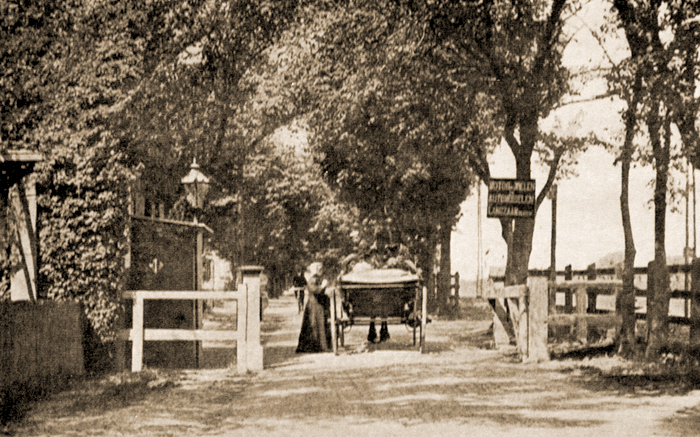
In 1826 work was started on the Zandvoortselaan. It stretched from Heemstede through Aerdenhout and Bentveld. The last part of it (called the Haarlemmerstraat since 1900) tagged on at the Hogeweg. It was 7 metres wide and finished in 1828. The surface was asphalted in 1920. There was a toll at the beginning and end of the road, and in 1828 the charges were as follows:[su_spacer size=”3″]
- a coach and six horses – 25 cents
- a man and his horse – 7,5 cents
- a person on foot – 3 cents
The toll was abolished in 1917, and now the only reminder of it is the Tolweg.
Eventually in 1954 the pre-war number of dwellings was once again reached.


